Layering Like Rick Owens: Mastering the Monochrome Stack
When it comes to shaping the modern silhouette, few names rival Rick Owens, the American living abroad who built a brutalist empire from a Paris studio. The Rick Owens way of dressing isn’t about pattern, color, or logo recognition; it is about architecture worn on the body. Layering occupies the very core of this philosophy, transforming flat garments into sculptural volume. If you have ever admired a Rick Owens fashion editorial and wondered how the look is engineered, the answer is almost always a carefully constructed stack. Piece by piece, this guide dissects the craft of monochrome layering, so you can build the same drama without guessing. By the time you finish, you’ll know the exact proportions, fabrics, and tonal shifts behind the technique.
Why Monochrome Is the Foundation
The thing most people agonize over first is coordinating color, yet Rick Owens removes the stress entirely by operating within a narrow tonal band. The house palette of black, dust, pearl, and milk allows every garment to belong to the same family, so nothing fights when you stack it up. With no contrasting hues to distract it, the eye reads texture and shape instead — exactly where the interest belongs. That’s why a black waxed-cotton jacket layered over a dust hoodie over a pearl tank looks deliberate instead of chaotic. Monochrome also shoots beautifully under the harsh runway lighting the brand prefers each season. For 2026, stylists are leaning even harder into single-tone columns, where roughly 70 percent of recent looks rest on a single dominant shade. Get this right first, and the whole system follows.
Building the Stack from the Skin Outward
A true Rick Owens layer opens with a long, lean base that clings to the torso and runs past the hip. A signature long tank or a thin ribbed tee in milk or pearl forms the slim foundation everything else drapes over. Here, length is the real secret weapon; a base that peeks out three Rick Owens US to five inches below the next layer adds the asymmetry the look depends on. Layered over it, a Rick Owens hoodie from the DRKSHDW diffusion line introduces the first hit of volume and weight. Retailing for 350 to 590 USD as a rule, the DRKSHDW hoodie is cut from heavyweight cotton that keeps an intentional slouch. Top off the core with an outer shell, and you’ve built a three-deep stack that still moves with the body. Keep every layer visible at hem, cuff, or collar, so the construction speaks for itself.
Proportion and Drape Rules
It’s proportion that separates the amateurs from the experts, with rules that are oddly strict for so loose-looking a brand. The core rule is lean on the bottom and full on top, or vice versa, yet never balanced. A cropped, boxy jacket pairs with slim DRKSHDW jeans, while a long draped cardigan demands tapered or pooled trousers beneath. Since drape rivals cut in importance, pick jersey, waxed cotton, and brushed wool that drape down instead of standing stiff. Skip stiff materials that work against the silhouette and disrupt the vertical line you’re trying to create. Recent collections’ cocoon coats, frequently near 2,400 EUR, push this drape to its limit. Keep the volume flowing downward and the whole stack will feel deliberate.
Must-Have Pieces for the Layered Wardrobe
Layering convincingly doesn’t require the entire archive — a few cornerstone garments handle most of the heavy lifting. When you invest in versatile staples, the same five or six items rotate into dozens of configurations. The table below lays out the core pieces, their typical prices, and each one’s role in the stack. Bear in mind a Rick Owens sale at major stockists can knock 30 to 50 percent off these numbers, so timing counts. Listed innermost to outermost, the pieces follow the order you’d actually dress in. This is meant as a shopping checklist, not a hard-and-fast order.
| Garment | Stack Role | Usual Price (USD) | Best Shade |
|---|---|---|---|
| Long ribbed tank top | Foundation / base | 190 – 320 | Pearl / Milk |
| DRKSHDW pullover | Mid-layer volume | 350 – 590 | Dust / Black |
| Draped cardigan | Middle drape | 690 – 1,100 | All black |
| The leather jacket | Outer layer | 2,800 – 4,500 | Pure black |
| The cocoon coat | Statement outer layer | 2,200 – 3,400 | Black / Dust |
Texture as the Secret Layer
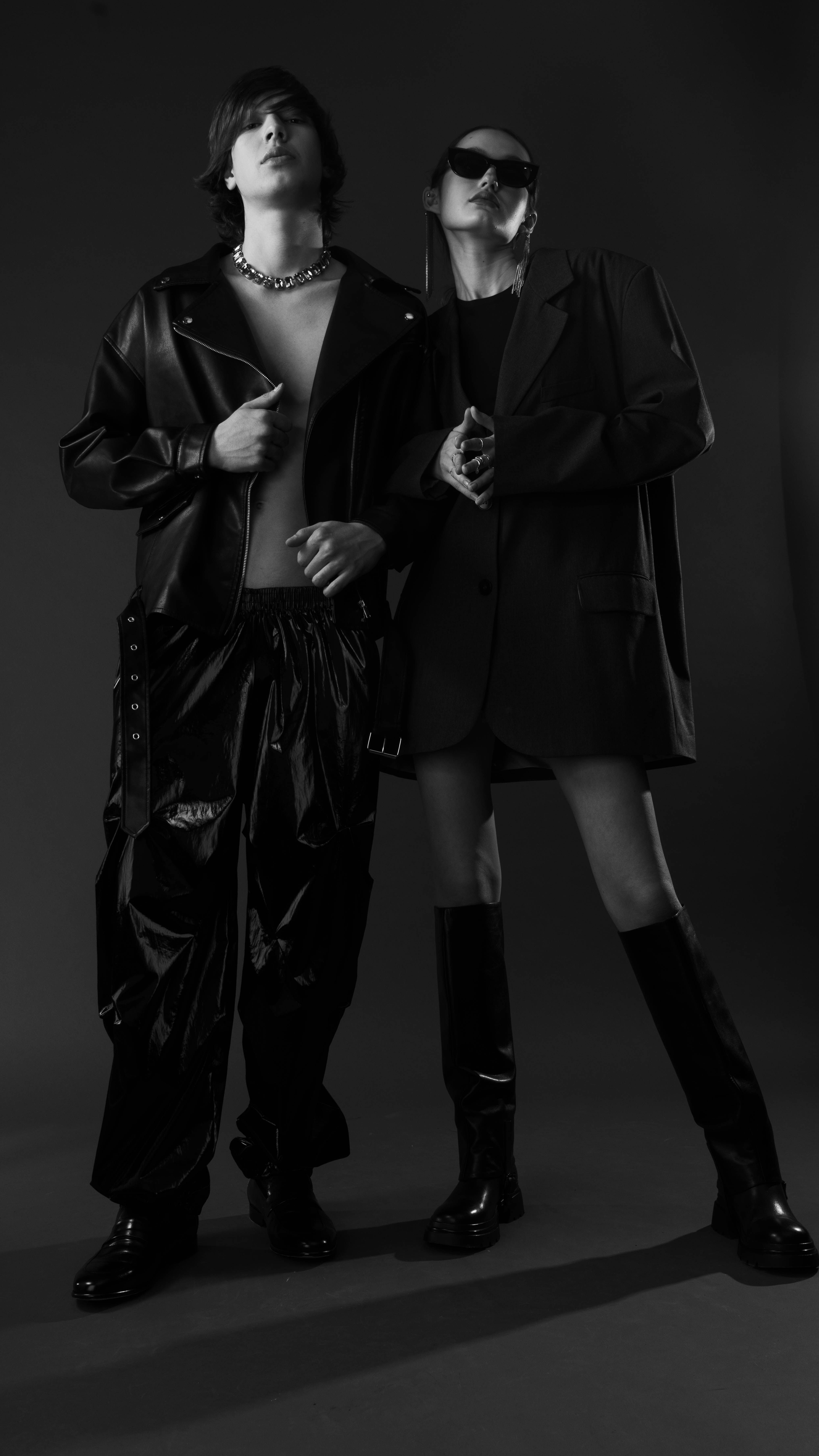
When everything is the same color, texture becomes the language doing the talking. What makes a monochrome stack work is matte against sheen, smooth against ribbed, brushed against waxed. Imagine a glossy leather jacket atop a chalky brushed-cotton hoodie atop a fine ribbed tank, every piece black. Even with technically one color on show, the viewer registers three distinct surfaces. This textural layering is what separates a flat all-black outfit from a true Rick Owens fashion moment. In 2026, designers are taking this even further through raw hems, coated denim, and felted wool surfaces. If your layers feel distinct to the touch, they’ll read as distinct to the eye — so always test it.
Footwear and the Base of the Stack
Layering carries below the waist too, where the lower half can finish or sink the whole silhouette. From the Geobasket to the Ramones to the DRKSHDW high-tops, Rick Owens footwear supplies the heavy anchor a draped top half requires. The Geobasket sneaker — a perennial icon at around 1,100 to 1,400 USD — supplies height and bulk to offset the volume above. Pooled or stacked trousers breaking hard over the shoe push the column to the floor and heighten the leanness. For a softer look, the DRKSHDW high-top in milk or black holds the palette consistent while adding street-ready ease. Socks pulled over trouser hems, a recurring runway touch, carry the layering idea all the way to the floor. Let the shoe be the building’s foundation stone, not something tacked on at the end.
Layering Mistakes to Steer Clear Of
A few predictable mistakes can deflate even the right pieces, turning wardrobe into costume. Most often, people match their layer lengths, which kills the asymmetry the look needs. Then there’s the stray accent color, which fractures the monochrome discipline and pulls focus. Overload the outer layers and you bury the base, making everything stiff and bulky. Blending warm and cool blacks is a subtler trap, because a blue-black jacket next to a green-black hoodie looks accidental. Finally, neglecting to leave hems and cuffs exposed buries the very construction you labored to create. Skip these five traps and the stack holds firm.
Tying It All Together for 2026
The beauty of the Rick Owens layering system is that once the rules are second nature, improvising becomes effortless. From a lean base to weighted mid-layers to a dramatic shell — and throughout, let texture do the color story’s work. Hold proportions deliberately unbalanced and anchor the whole thing with heavy footwear. For richer inspiration, head to the current collections at rickowens.eu or look at how editors put the looks together on Highsnobiety. If money’s tight, watch for a Rick Owens sale around the seasonal transitions, when entry pieces like a Rick Owens hoodie become far more attainable. Once you’ve mastered the monochrome stack, and you’ll own a wardrobe that feels architectural, intentional, and unmistakably modern in 2026.